A physical talkbox sends an instrument through a tube into the performer’s mouth. The mouth shapes the sound acoustically and a microphone picks up the result. No plugin reproduces that path literally, because the filter in a real talkbox is a human head moving in real time.
What a talkbox plugin does is imitate the audible result through vocoding, filtering, resynthesis or modelled envelope behaviour. That is why software usually lands closer to “vocoder” than to a tube-driven talkbox, and knowing which one you actually want saves a lot of frustration.
Quick answer: NEOTUNE Pro at $29.99 if you want the talkbox after a corrected lead in one window, VocalSynth 2 at $199 for a dedicated toolbox, OVox when it should play like a synth, Arturia Vocoder V if your reference is classic robot speech rather than a talkbox at all.
Disclosure: ProducerSources makes NEOTUNE Pro and sells several of the other plugins compared here. Prices were checked on September 26, 2026 and change often. Our ranking criteria are stated in full so you can weigh them yourself.
Talkbox, vocoder and resynthesis are three different things
Worth getting straight, because the words are used interchangeably in shops and they should not be.
Talkbox. An instrument signal is physically piped into a mouth and reshaped by it. Very bright, very immediate, and the imperfections of a real mouth are the character. Peter Frampton, Roger Troutman, Daft Punk’s “Around the World”.
Vocoder. A machine analyses the spectral envelope of one signal (the voice) and imposes it on another (the carrier), usually across a bank of bands. More even, more electronic, more controllable. Kraftwerk, ELO, most robot voices.
Resynthesis. The voice is analysed for pitch, amplitude and formant, and those measurements drive a synthesiser. The voice is not in the output at all, only its behaviour.
Most “talkbox plugins” are doing the second or third thing with the character of the first. That is fine, but it explains why a plugin rarely sounds like a tube in somebody’s mouth.
Quick comparison
Price checked September 26, 2026.
| Plugin | Approach | Best for | Price at check |
|---|---|---|---|
| NEOTUNE Pro | Built-in talkbox, 10 carrier waveforms | A tuned vocal that then becomes a talkbox | $29.99 |
| iZotope VocalSynth 2 | Dedicated Talkbox plus four other engines | Deep vocal sound design | $199 |
| Waves OVox | Vocal resynthesis, sidechain carrier | Playable synth-vocal effects | $99 list, sales vary |
| Arturia Vocoder V | 16-band vocoder with synth and sampler | Vintage vocoder, not strictly talkbox | EUR 149 |
| Image-Line Vocodex | Vocoder | FL Studio users, detailed band control | Varies by edition |
1. NEOTUNE Pro – best integrated talkbox workflow
The Talkbox module offers ten carrier waveforms, plus drive, speaker character and a sibilance control, and it runs after the vocal has already been through clean-up and pitch correction.
That order is the argument. A talkbox stage is only as good as the harmonic information it is given, and a stable, centred, in-tune performance gives it much more to work with than a raw take. Running a tuner into a separate talkbox plugin achieves the same thing across two inserts; having both in one window means the correction settings and the talkbox settings are visible together while you adjust them.
The same window also has formant shifting, vibrato, two harmony voices, compression, drive and growl, which covers most of what you would reach for after the effect.
Choose it when the talkbox is one layer of a modern vocal rather than the entire production. Choose VocalSynth if the effect is the production.
$29.99, one payment. Hear NEOTUNE Pro
2. iZotope VocalSynth 2 – best dedicated toolbox
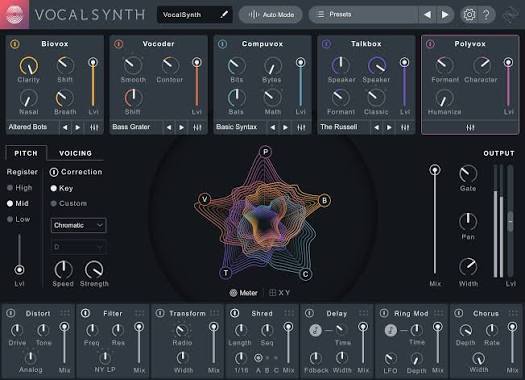
Separate Talkbox, Vocoder, Polyvox, Compuvox and Biovox engines, plus a full effects section, and three control modes: Auto follows the input, MIDI lets played notes control the pitch, Sidechain takes an external carrier.
The breadth is genuinely excellent and the Talkbox engine is one of the better software approximations available. The $199 and the fairly dense processing are unnecessary if you want one simple tone, and the interface rewards time spent.
3. Waves OVox – best playable resynthesis
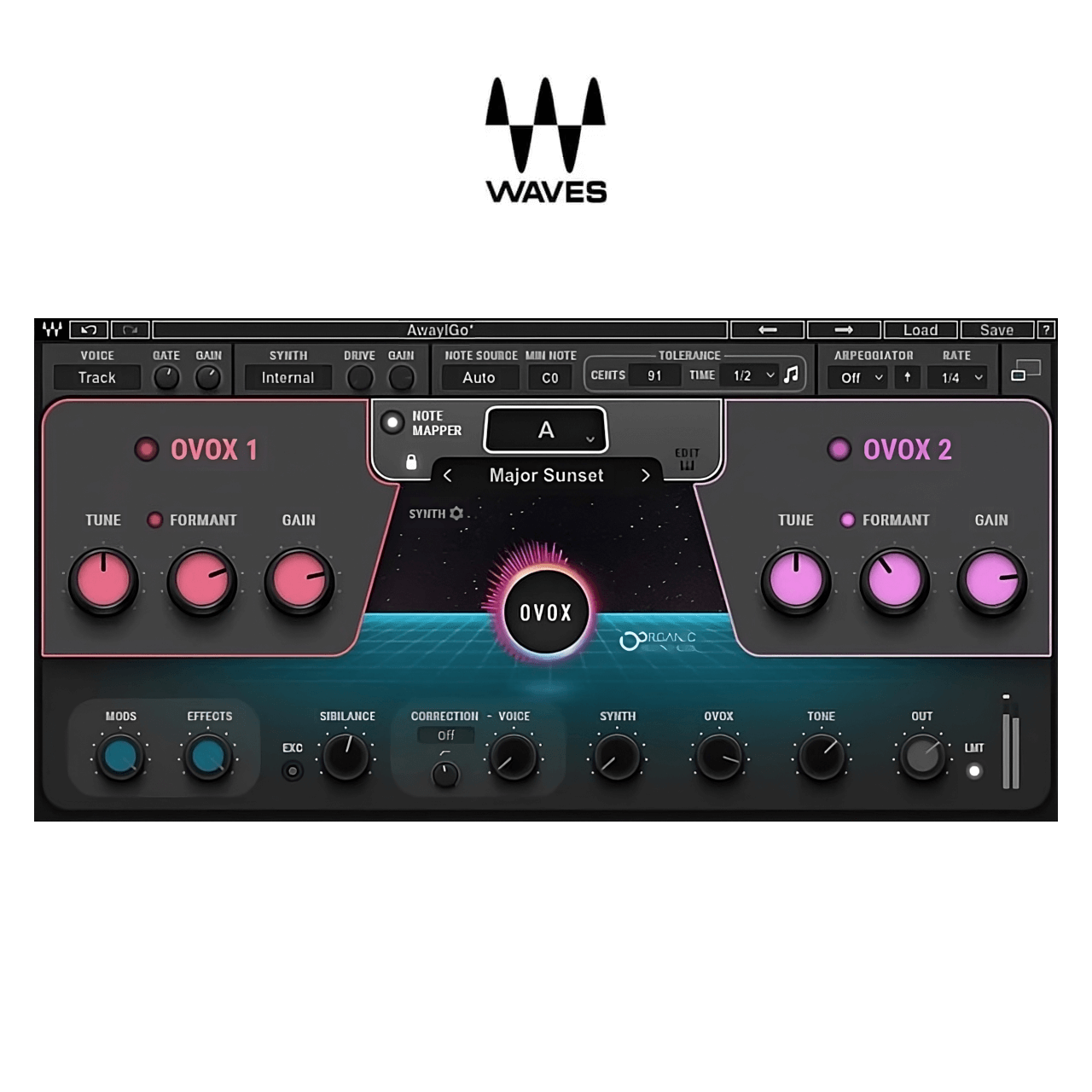
OVox extracts pitch, amplitude and formant from the voice and maps them to two synthesis engines. It can use an internal source or a sidechain carrier, map notes and chords, arpeggiate, and send MIDI out to another instrument.
This is the strongest choice when the “talkbox” should behave like a synth you play rather than an effect you put on a voice. OVox on ProducerSources
4. Arturia Vocoder V – best vintage vocoder

A modelled 16-channel vocoder with a dual-oscillator synth, a sampler, modulation and effects.
It is not a talkbox emulation and does not claim to be. It is the better recommendation when the reference in your head is classic robot speech, vocoded pads or harmonised electronic vocals, which is what a lot of people mean when they search for a talkbox. On ProducerSources.
5. Image-Line Vocodex – best for FL Studio owners

Detailed control of analysis and synthesis bands and carriers. Before buying anything else, check whether it is already included in your FL Studio edition. Compare FL Studio editions
Why sibilance decides intelligibility
This is the section that fixes most talkbox problems, and it is almost never in the manual.
Vowels carry pitched resonances, so any carrier with harmonic content reproduces them easily. That is why the melody always comes through. Consonants like S, T, K and F are noise bursts with little or no stable pitch, and a vocoder or resynthesiser has very little to work with. If the processor does not preserve or synthesise that unvoiced energy, the lyrics vanish and you are left with a tuned buzzing noise that is clearly saying something.
If the plugin has an unvoiced or sibilance control, use it. NEOTUNE Pro’s Talkbox module has one.
If it does not, do it by hand:
- Duplicate the dry vocal.
- High-pass the duplicate at around 4 to 6 kHz.
- Compress it fairly hard so the consonants are even.
- De-ess only if it is harsh, not on principle.
- Blend it under the effect until the words arrive, then stop.
You need less of this than you think. The moment you can make out the lyric, the level is right.
Keep the carrier bright. A sine wave has one harmonic, so the filters have nothing to shape and the result is muffled regardless of what you do afterwards. Saw and pulse waves work because they are harmonically rich.
A working recipe
- Record exaggerated diction. Over-articulate. This is a performance problem before it is a plugin problem.
- Tune or stabilise the input first. The effect follows the pitch it is given.
- Pick a bright carrier. Saw or pulse. Avoid sine.
- Match the carrier notes to the song’s chords, by MIDI where possible.
- Raise the band resolution or clarity until words start to emerge.
- Blend in the controlled dry sibilance from the section above.
- Only then add short delay, chorus and saturation.
Solving intelligibility before adding effects is the whole trick. Reverb on an unintelligible talkbox makes it less intelligible, and most people respond to that by adding more reverb.
Common failures
You can hear the melody but not the words. The carrier lacks high harmonics, or the unvoiced consonants are being suppressed. Brighter carrier, more sibilance blend.
It sounds thin. A talkbox effect strips low end. Layer the effect over a quiet dry vocal, or add saturation after it.
It sounds like a vocoder, not a talkbox. It probably is a vocoder. That is what most software does. Drive and a brighter, less even carrier get you closer.
The pitch is wrong against the chords. Drive the carrier from MIDI rather than letting it follow the voice.
Adding reverb made it worse. Solve the words first. Reverb last.
Frequently asked questions
Is a talkbox the same as a vocoder? No. A talkbox uses the performer’s mouth as a physical acoustic filter. A vocoder analyses one signal and applies its spectral envelope to a carrier. Software sold as talkbox-style usually approximates the audible result through processing rather than modelling the tube.
What is the best talkbox plugin in 2026? NEOTUNE Pro at $29.99 if you want it after a corrected lead in one window, VocalSynth 2 at $199 for a dedicated toolbox with five engines, OVox when the effect should play like a synth.
Why can I hear the melody but not the words? The carrier lacks high harmonics, the consonants are being suppressed, or the diction is too relaxed. Fix the sibilance transmission before adding any more reverb.
Do I need MIDI for a talkbox plugin? Not always, but MIDI gives you exact carrier notes and chords, which is the only reliable way to control the harmony of a phrase.
What carrier waveform works best? Saw or pulse. Something harmonically rich. A sine wave gives the filters almost nothing to shape and sounds muffled no matter what you do next.
Can I get a talkbox sound without buying anything? A stock vocoder in your DAW with a bright saw carrier gets close. Most DAWs ship one, and FL Studio’s Vocodex is included in some editions.
Should I tune the vocal before or after the talkbox? Before. The effect follows the pitch information it is given, and a stable corrected input produces a cleaner result.
Is a real talkbox better than a plugin? Different, not better. A real talkbox has a character the software approximation does not, and a plugin has repeatability, no leakage into the mic and no tube in your mouth.
NEOTUNE Pro has a ten-waveform talkbox with drive, speaker and sibilance controls, running after the clean-up and correction stages in the same window. $29.99. See the plugin.
Related: vocal harmony plugins and formant shifting explained.
Also: how to make hyperpop vocals, where the talkbox is one layer of a stack, and the hard autotune effect for stabilising the input first.
The post Best Talkbox Plugins in 2026 appeared first on Producer Sources.