u-he head honcho Urs Heckmann talks us through the development of Zebra 3, staying relevant in an era of sample packs and AI, and weathering industry storms for 25 years.
This year marks 25 years of plugin developer u-he. Rather than rest on its laurels, the company has released perhaps its biggest instrument ever: Zebra 3. A complete rewrite of version two, Zebra sees the semi-modular sound design playground grow in surprising ways, with new spline-based morphing oscillators, modal resonators, and much more. We spoke with u-he founder Urs Heckmann about the process of making Zebra 3 and how the company manages to stay relevant with so much changing in the industry.
Attack: Zebra 3 is here. What was your goal with the instrument? It’s a complete rewrite of the code, isn’t it?
UH: Zebra 2 came out more than 20 years ago, and since then, it has grown through nine or 10 major feature updates. Some of the ideas that were implemented in the early versions weren’t fully consistent with features that were added later. That led to a number of inconsistencies that Zebra fans have tolerated very gracefully, but I always had the wish to start over and make things much more consistent. At the same time, we’ve learned so much over the years that several of the ideas in Zebra 2 were begging to be reimplemented using more modern features and everything we know now.
What’s new in Zebra 3 compared to version 2?
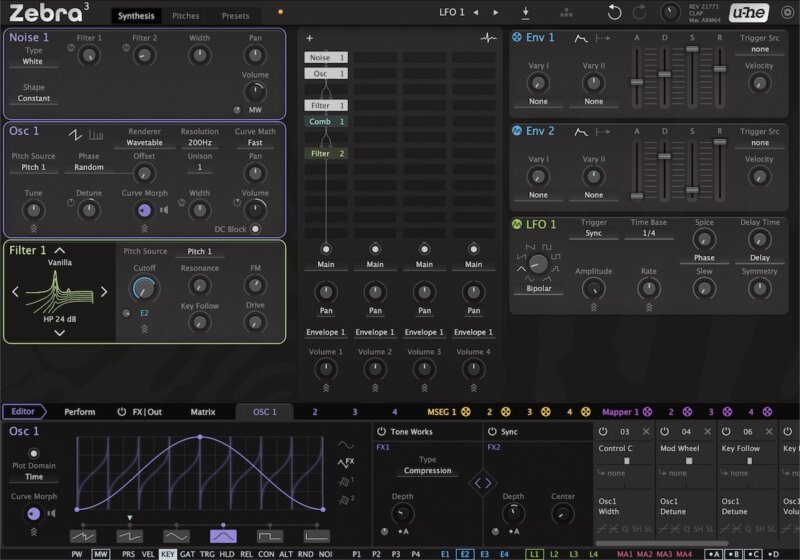
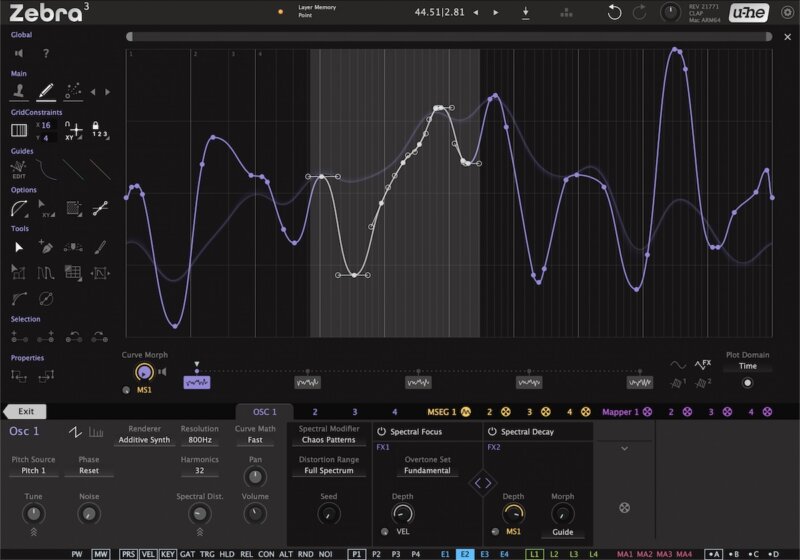
First of all, we added these very deep editing tools for oscillator waveforms and MSEGs. They both use the same set of tools now, and you can even copy and paste between them. That’s exactly the kind of consistency I was talking about.
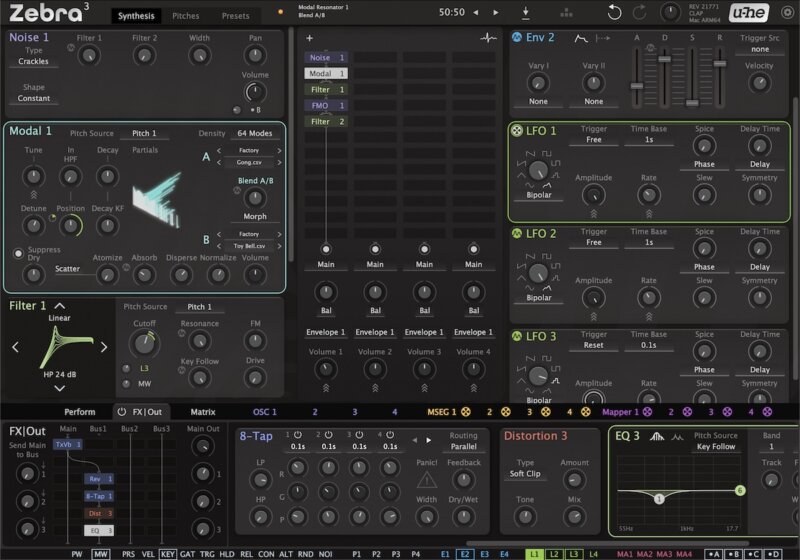
Next up, we added modal resonators as another approach to physical modeling alongside the comb filters, with separate exciters as an addition to noise. Those open up some entirely new worlds of sound in Zebra.
But maybe most importantly – and this is often overlooked when people just read feature lists – we added those four pitch modules, and made many of the modules triggerable by internal signals. That puts Zebra on a whole different conceptual level, giving it easy access to sound design options more commonly associated with a rack of hardware modules.
Then, of course, pretty much everything in Zebra 3 has become more powerful, with better quality. Now that MSEGs can be used as envelopes, the regular ADSR type has become simpler and more accessible. We completely refurbished some of the other modules, for instance, the ring modulator and the FM oscillator, which is now an operator pair.
Why update Zebra now?
Quite simply because we couldn’t do it any earlier! Our last new software release before this one was Twangström, which was seven years ago. Since then, we’ve mainly been polishing our existing portfolio and putting everything on a more modern foundation – including plugins that pre-date Zebra 2, like Filterscape from 2004. That took ages! During this time, we also co-authored CLAP, a new plug-in standard, and released our first few hardware products. For the past three or four years, I’ve been working more or less full-time on Zebra 3. Other developers joined in after finishing their projects.
Why did you go the public beta route this time?
We always do that. We always present a new product as a public beta and get several requests for changes. This stage usually takes four to six weeks, but this time it took four months. Zebra 3 is such a complex product, we realized from the feedback that not only did we have to improve some things under the hood, we needed a whole new user interface.
Is there a marketing component to a public beta as well? In the past, the idea was to keep new features a secret to build interest, but now public betas are more common. Does this build community?
A public beta is a good opportunity to offer the product at an introductory price. That’s also what we did here. Posting a public beta can mean that the product loses some momentum by the time it’s released, but I’ve never really cared about that.
But most of all: nothing is worse than a product release of something that doesn’t work properly. The public beta period gives us confidence about what does work, and lets us fix things that don’t.
Most people don’t realize how much work goes into creating a piece of software like Zebra. How many total man-hours do you think have gone into it?
Haha, that’s impossible to say. For myself alone, it would add up to something like five years, assuming a 40-hour week. On top of that, somewhere between six and 12 other people worked on it for two or three years. Not forgetting that a lot of the development that went into Hive and Repro was done with Zebra 3 in mind, or the 25 or so sound designers who put several months into this as well.
[quote align=right text=”We still get messages like, “Hey, look what I did with Zebra 2!” from people who’ve been using it for 20 years but still discovered something new.”]
What was the biggest challenge in making Zebra 3?
Not giving up. This thing is so complex. I mean, we had to change things like the format of our user UI scripts to save a second or two when opening the interface. It simply took too long to load in the old format. And every month or two, you hit a point where yet another part of it turns out to be 10 times bigger than you expected. Then you have to find both the solution and the motivation to deal with it.
What are some features that you think people might miss, or that you want users to take notice of in Zebra 3?
I mentioned the Pitches section and the triggers. But there’s also the playability. We make sure every preset is as dynamic as it gets. People are excited that they can use MPE and pair it with microtonal pitch slides and real-time microtuning via MTS-ESP. Zebra 3 isn’t our first product to support MTS-ESP, but it is our first to do so in real-time.
About the triggers: if you use gate as a trigger for sample and hold, you can ‘freeze’ real-time controllers like the modulation wheel for that note only. This concept alone, as simple and stupid as it sounds, opens up a lot of expressive possibilities.
Why do you make your instruments so deep? Are people really pushing them all the way?
We also make very easy stuff. But yes, I guess it started with deep instruments. My first plugin was More Feedback Machine. At a time when delay plugins typically had maybe five to 10 parameters, More Feedback Machine had 89. I guess it became a habit that I just kept adding parameters. I always had good reasons for it – or rather, good excuses. And people absolutely do use our instruments in ways we never expected. So yes, I think they really do push them all the way.
I mean, we still get messages like, “Hey, look what I did with Zebra 2!” from people who’ve been using it for 20 years but still discovered something new.
You must be proud of the legacy of the Zebra series and how it’s been used by big players like Hans Zimmer. What are you especially proud of?
We haven’t done anything that people didn’t like – but I’ve only ever done what I wanted to. We don’t do big market research and hold meetings about “What should we do next?” We merely ask ourselves, “What do we want to do? What’s fun?” It somehow aligns with what other people want.
What’s changed in music production since 2003 when the first Zebra was released?
Hahaha, don’t ask me… I make plugins, and I talk to people who produce music, but I hardly make music myself. I’m much more fascinated by synthesis than I am by electronic music as such.
With the rise of sample use and now AI, how does an instrument like Zebra 3 fit into the modern music production landscape?
This may sound trivial, but I think what most people seek is authenticity. With AI, people only talk about the AI, not about the person entering the prompt. As a means of expression, this concept isn’t viable. It’s a gadget and already something people seem to be getting tired of. Who needs more slop?
Sampling is a different matter. It’s a quick and reliable way to do something realistic, but then it’s stale. You often have to use brute force, gigabytes of samples, to make a sample-based instrument sound alive. That’s a perfectly valid approach, but it doesn’t always work. Zebra, in particular, has enabled people to create dynamic, lifelike instruments and use them alongside real orchestra and real instruments in situations where samples just weren’t ‘alive’ enough. Because you can still modulate any parameter, the synthesis process is more dynamic than choosing a sample from a pool and playing it back.
Have you, as a company, had to re-evaluate how you do things given all the changes in the industry, or have things been smooth sailing?
We’ve had our fair share of trouble. In the past two years, two of our resellers went bankrupt and left us high and dry with about a quarter of annual revenue. That appears to be a direct result of predatory investment strategies.
But I set up u-he – or Heckmann Audio, the company behind u-he – to be a resilient and, if I may say so, simple family business. We don’t pursue endless growth and we have neither investors nor debt. We don’t do greed, but we also don’t do cheap.
Thanks to some incredibly successful products, everything has worked out so far. Also, maybe because we never took part in a ‘race to the bottom,’ or went down dead ends, such as subscription models. We’ll see. I’m confident that Zebra 3 is going to be a worthy successor to Zebra 2 – which lives on in Zebra Legacy – in our portfolio.
Find out more about Zebra 3 at the u-he site.
[social-links heading=”Follow Attack Magazine” facebook=”https://www.facebook.com/attackmag” twitter=”https://twitter.com/attackmag1″ instagram=”https://www.instagram.com/attackmag/” youtube=”https://www.youtube.com/user/attackmag” soundcloud=”https://soundcloud.com/attackmag” tiktok=”https://www.tiktok.com/@attackmagazine”]
[product-collection]