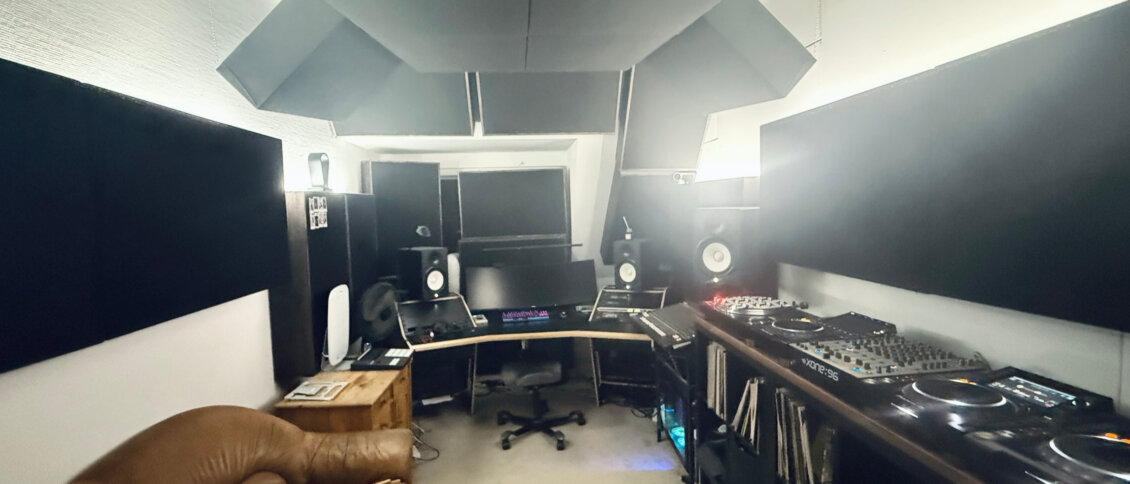
With System Collapse out now on Dax J’s Monnom Black, Berlin’s Lars Huismann shows us around the attic studio where it was made.
The eight-track release follows his 2024 Monnom Black debut, Mechanized, and the Sounds From The Past trilogy on Mutual Rytm. A trained drummer who has run his own LHR imprint since 2015, Huismann builds his tracks from hypnotic percussion, dub chords and long filter movements. Here he talks us through the room, the hardware and the FL Studio techniques behind the record.
The Studio
The studio is on the top floor of my flat, around 20 square metres in total. Having it at home matters more to me than any piece of gear. I run a consultancy alongside the music, so production happens whenever there’s a gap in the day. I change rooms, and I’m in the studio. Everything is patched and ready, so an hour between two calls is a real hour of work.
Twenty King Kong bass traps from Kiss Your Ears in Berlin handle the mid and low end. In a small room under a sloped roof, bass frequencies are the whole problem. In 2022 I also had extra layers added to the floor and walls: Fermacell boards and polystyrene on top of the parquet for the neighbours below, and Diamant boards, plasterboard, and rock wool on the walls.
It’s all only screwed together, so when I move, it comes off again. That’s my tip for anyone renting: you can treat a room properly without touching the building.
Yamaha HS8 And SPL Phonitor One
My monitors are Yamaha HS8s. Nothing special, but I like the neutral sound, and in a room this size, neutral is what counts. I’ve had them for about fifteen years, so I’ve mixed every record I’ve made on them.
On top of the HS8s I run Sonarworks SoundID Reference. There’s no subwoofer in here yet, and the HS8s are a bit shy in the sub range, so the correction fills in what I can’t hear otherwise.
For details, I go to headphones a lot, and they run through an SPL Phonitor One. The Phonitor’s crossfeed makes a headphone mix feel more like speakers, so what I hear there translates better when I switch back to the HS8s.
RME MADIface USB And Ferrofish Pulse 16 MX
My sound card is an RME MADIface USB, and the analogue side is handled by a Ferrofish Pulse 16 MX AD/DA converter. The two communicate over MADI, with one optical cable carrying all the channels, and the Pulse converts them into sixteen analogue inputs and outputs.
Every synth, the tape deck, the compressor and the desk have their own channels, so I can route all my hardware in and out of FL Studio without re-patching anything. I open the project, and the hardware is already there.
Mackie SR24-4-VLZ Pro
The newest piece in the room: I’ve only had the Mackie since early October, from Tarkno, a producer and DJ, and I’m already a big fan. I use it mainly to record drums.
What I love is the dirty character, especially when you drive it slightly into the red. The preamps and the EQ add grit that a plugin saturator doesn’t give me the same way, and because every channel has its own gain and EQ, I can treat each drum element separately on the way in. It’s the opposite of a clean summing box, and that’s exactly why it’s here.
What I don’t love: the faders, knobs and switches are old and sensitive, and you can hear them crackle when you move them. Part of the character, but also a reminder that it’s a desk from another decade. Several tracks have already been recorded through it; they’re going on my next Monnom Black EP and my next Mutual Rytm EP.
[quote align=right text=”People on a floor don’t dance to the kick drum; they dance to what happens between the kicks”]
Tascam 122MKII And Alesis 3630
The Tascam 122MKII is a three-head cassette deck, and the Alesis 3630 is a compressor that most people would call cheap. Together they were the sound of the Sounds From The Past trilogy on Mutual Rytm: I used the combination partly on the master and partly on the drums.
Tape is the glue over everything. I like the imperfections of early-2000s sampling, the audible limits of the machines people used then, and tape is my way of getting that back: dirt instead of polish, so the record doesn’t sound like it was made in 2026.
The three heads are the reason it’s this deck and not any old cassette player: you can monitor off the tape while recording, so you hear the saturation as you set the level. The downside is just as real: sometimes a pass comes back a bit too lo-fi for a techno production, and then I have to fix it in the DAW. That’s the price of the glue.
The track where you can hear the tape most clearly is ‘Orbital’ from the Mechanized EP. There it’s only the drums that went through the tape: listen from the first bar.
Roland JV-2080 And Super JV-1080
I have two of the classic Roland ROM synths in the rack: a JV-2080 and a Super JV-1080. The one you can hear clearly on record is the Super JV-1080, on ‘Fusion’ from my Mutual Rytm days: the pad and the bass stab, with the filter resonance turned up high, were recorded from it and then processed further in FL Studio.
The bass stab is there right from the start; the filtered pad first comes in at 0:30. The JVs take a lot of time to learn and adjust, and the JV-2080 is next in line.
DJ Setup
The room has a DJ wall: an Allen & Heath Xone:96, a CDJ-3000, a CDJ-2000NXS2, a CDJ-2000NXS, a Technics SL-1210MK2, and a Reloop RP-7000MK2.
I play the Xone:96 and the 3000 at most clubs, so my home setup matches what I use in the booth. Not every booth has 3000s, and I don’t want to think about the hardware on the night. Two turntables because I still buy and play records, and because my own releases come on vinyl; test pressings get checked here before they’re approved.
FL Studio
One thing first, because I hear it all the time. I make this music in FL Studio, and I’d choose it again. In techno, it still carries its old name, Fruity Loops, and the image of a huge user base in commercial EDM and hip-hop. A lot of people in techno never looked past that image. Their loss.
It’s a superb DAW: hardware integration is easy, and it does everything Ableton does, and more. I’ve been working in FL Studio for fifteen years, and I know the program from the other side as well: from May 2020 to May 2023 I was Performance Marketing Manager at Image-Line, the company behind FL Studio.
Filters Instead Of Melodies
This is the heart of my production. The short version: instead of writing a melody, I use filters to create variation and patterns.
I start with a chord, usually a minor or major chord detuned slightly so it sits a bit off and creates tension, often as a hybrid of a polyphonic synth and a sample. Then I program a MIDI pattern that’s about groove, not melody. And instead of a melody I create a filter-modulation pattern for cutoff and resonance, via an LFO or a second MIDI pattern. Because the resonance highlights certain frequencies, the ear reads that movement as a melody even though there isn’t one. Most of the movement in my tracks is one parameter travelling for a very long time. The question stopped being ‘what’s the melody?’ and became ‘how does space move?’
The source itself matters less than people think. What the signal goes through afterwards is what decides the character.
Output Movement is the one I’ve been using for a few years now, and it sits on a lot of my elements, synths and percussion alike. I like its filter because it has a very interesting dirty, slightly distorted character, which is exactly what I want on a dub chord. Movement’s rhythm section is the other reason I keep it: it lets the filter move in a pattern rather than just sweep.
The latest step with Movement is a modular stereo effect I built in VCV Rack, which I call ‘Dual Motion’. Output Movement sits at the centre, loaded as the host effect. Behind it, I’ve wired separate filters and delays for the left and the right channel. An eight-step sequencer moves the filters in time with FL Studio, and a slow LFO changes the tone of the echoes. The idea is to get rhythmic and spatial changes from a simple dub chord or percussion track without constantly adding new notes.
DuoPulse
One more filter tool I built myself: DuoPulse. I made it because I wanted to sequence this kind of movement more precisely than the tools I had allowed.
It has two rhythm units that run independently; each can be a step sequence of up to 32 steps, an LFO, or an envelope follower, and each can move the volume, stereo position, and a master low-pass filter with four gently saturating stages. Two rhythm units instead of one is the whole point: one can carry the groove, the other can open and close the filter against it, and the two patterns don’t have to share a length.
‘Grid’ is the clearest example. The dub chord is the driving element next to the drums, and the filter does the work on it. Every eight bars, a second dub chord comes in with a lot of reverb and its own cutoff automation. Almost the whole of System Collapse runs at 145 BPM, and ‘Grid’ and ‘Anomaly’ are my answer to the idea that dub techno has to be slow. It doesn’t.
FL Studio Patcher
Patcher is a part of FL Studio that many people overlook, and it’s one of my main workflow tools. It lets you build complex chains of instruments and effects inside one container and save the whole thing as a single preset. With filters, modulation, and routing already in place, I start from a sound that moves, not an empty channel. If the chain is already there, I’m making music within a minute instead of rebuilding a signal path.
The example in the screenshot is one I use a lot: ‘Dub Motion’, with Output Movement at the centre, a high-pass and a low-pass around it, separate level controls for the dry and the effect signal and a limiter at the end so nothing gets out of hand. One preset, and a dub chord already moves.
[quote align=”right” text=”FL Studio is a superb DAW: hardware integration is easy, and it does everything Ableton does, and more”]
Arturia Acid V And Pigments
Two tracks on System Collapse, ‘Corrosive’ and ‘Cult Breaker’, use a classic 303 as an emulation: Arturia’s Acid V. Ever since the 303 came out, there have been thousands of acid tracks, and they all follow the same pattern. The 303 already has its own filter and its own very particular character. I wanted to put another one on top, so I built my own filter sequence over the acid line, with rhythmic emphasis and LFOs, and kept going until the line stopped behaving like a standard acid element.
The result is a sound that gets very full, and you can play it very deep without losing anything. The extra filtering comes from Pigments, this time loaded as a plugin on the effect side rather than as an instrument. Yes, that works, to my own surprise. My goal wasn’t to get too trancy, but to find a middle ground and keep the rhythmic density high.
One thing that helps a lot: don’t program too many notes, so the processing step afterwards, Pigments and its filters, still has room to build something new on top.
Pigments as an effect in FL Studio only works under two conditions. First, it needs the Utility engine with Audio In as the source, with the other two engines switched off; in this case, the audio coming in is Acid V. Second, it still needs a MIDI signal, so you build the rhythm anyway. The sequencer inside Pigments then runs while you hold that note and opens and closes the filter step by step. That’s where the acid line stops being an acid line.
Rob Papen BLUE-III: ‘Neon Shadows’
‘Neon Shadows’ opens System Collapse. It’s also the oldest track on the record. I built the FM synth in BLUE-III from Rob Papen. I reach for FM whenever a track needs a melody: it always has a metallic core and a hint of detune, which keeps a melodic track dark rather than sweet. I recorded it as a sample, then kept working on it in Pigments’ sample editor.
The track has two FM sequences that answer each other. The first one has no melody, only a rhythmic sequence, tuned to a drone that runs constantly in the background; think of it as percussion. After the intro, a second FM comes in, the same sound, and this one has a melody that I built in the Pigments sequencer.
The bass drone underneath gives the two FM synths a completely different colour when you hear everything together. The mood is deliberately hopeful. The record is mostly darker, and I wanted a point of contrast. The line between euphoric and cheesy is thin there, and the whole job was staying on the right side of it. I made a lot of versions over the years and only finished it when Dax J showed interest.
Drums
D16 Drumazon 2 is my drum machine for almost everything except the kicks: percussion, hats, the rest. It’s on every one of my tracks.
Over the last fifteen years, I’ve built my own sample library, and the kicks are its core. I keep changing those samples, layering them with others, and every time something new comes out of that, I save it as a new sample and put it back in the library. Everything on System Collapse comes from that library and my own recordings.
‘Reversed Alignment’ is a good example of how far that goes. The main element is a monks’ mantra. Monk chants have been used to death, especially in Goa trance, and they bore me by now, so I wanted to do something else with one: I reversed the sample, cut it into pieces, and fitted them to the rhythm until the voice stopped being a voice and became percussion.
FL Studio’s Edison is the audio editor that every recording and sample is edited in. In the Sampler channel, a volume envelope with a fast decay shapes the tail of a kick or shortens a percussion hit without touching the sample itself.
One plugin I use a lot on the drums: the Black Box HG-2MS from Brainworx, a model of a tube saturation unit. It’s there for signature and saturation, the same job the tape and the Mackie do on the hardware side, but inside the box and on every drum channel that needs a bit more weight.
It’s worth mentioning that a lot of how I program drums comes from playing them. I spent about fifteen years behind a kit, in jazz and progressive metal bands. Jazz taught me groove; metal taught me to hold a pattern together while everything around it tries to fall apart. A drummer’s reflex is to fill, and techno asked me to erase. People on a floor don’t dance to the kick drum; they dance to what happens between the kicks.
System Collapse is out now on Monnom Black, digitally and on vinyl. Find Lars Huismann on SoundCloud and Instagram.
N.B This post may contain affiliate links. If you make a purchase through them, we may earn a small commission at no extra cost to you. This does not influence our reviews or recommendations. It just helps us keep the lights on.
[social-links heading=”Follow Attack Magazine” facebook=”https://www.facebook.com/attackmag” twitter=”https://twitter.com/attackmag1″ instagram=”https://www.instagram.com/attackmag/” youtube=”https://www.youtube.com/user/attackmag” soundcloud=”https://soundcloud.com/attackmag” tiktok=”https://www.tiktok.com/@attackmagazine”]
[product-collection]