Waves Tune Real-Time does one thing and does it well: it corrects pitch fast enough that a singer can monitor through it without being thrown off. People look for a Waves Tune Real-Time alternative for one of three reasons. They want more than tuning in the same window, they have hit its limits on scales, or they want a perpetual licence outside the Waves ecosystem.
Quick answer: NEOTUNE Pro is the same $29.99 and adds clean-up, formants, vibrato, harmony, talkbox, FX, MIDI and 37 scales. UAD Topline Vocal Tune is better if you track through an Apollo. Graillon 3 is free and genuinely usable. If the lowest possible monitoring latency is the only thing you care about, Waves Tune Real-Time is still the focused answer.
Disclosure: ProducerSources makes NEOTUNE Pro and also sells Waves Tune Real-Time. Prices were checked on September 26, 2026 and change often, Waves pricing particularly.
What Waves Tune Real-Time is built for
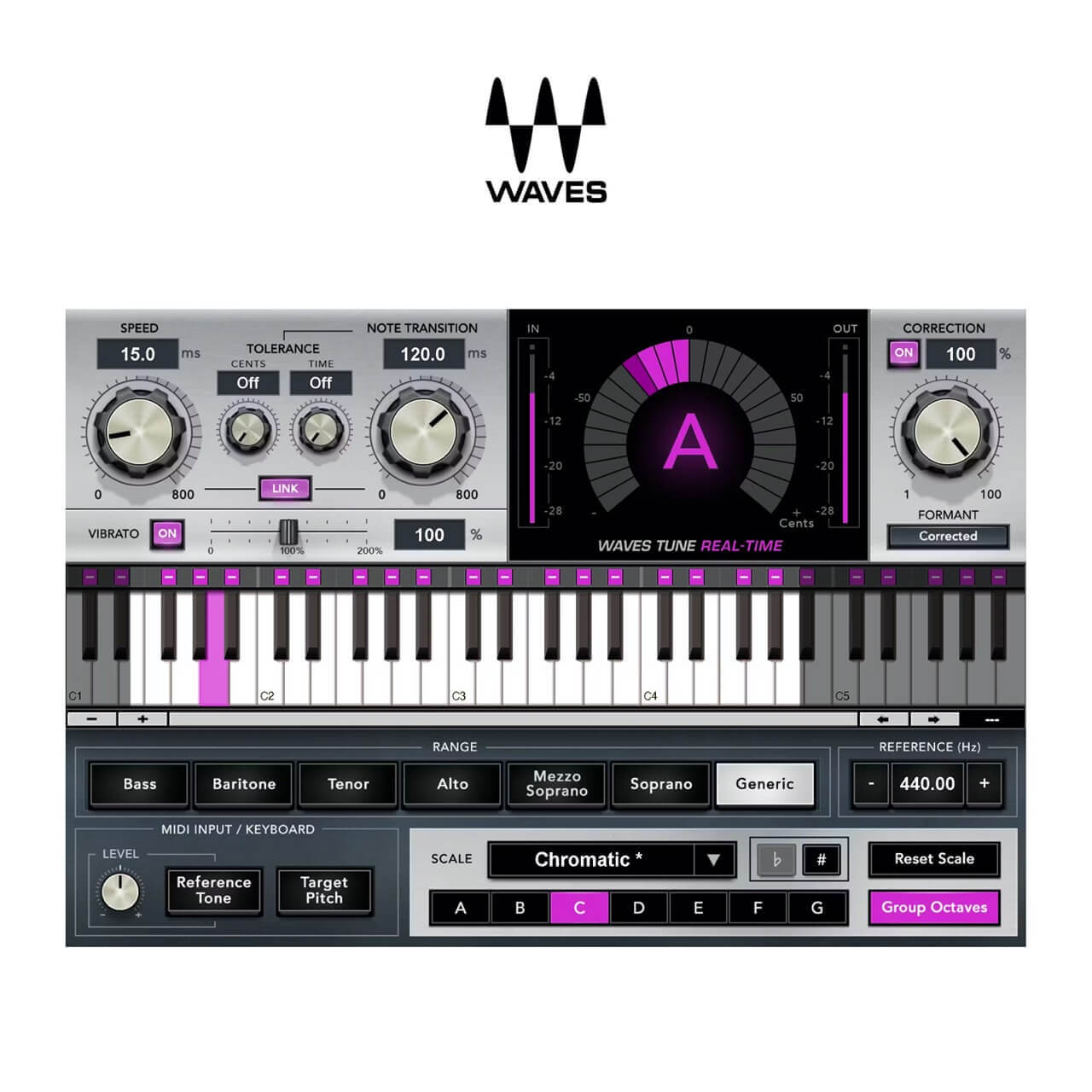
Latency. The design goal is a vocalist hearing themselves corrected while they sing, with the delay low enough not to put them off. Everything else is subordinate to that, and it is genuinely good at it.
That focus is both the strength and the limit. There is no clean-up stage ahead of detection, no harmony engine, no talkbox, and the scale list is the standard Western set. It corrects pitch, quickly, and hands back a vocal that still needs the rest of a chain.
Comparison
Price checked September 26, 2026. Waves discounts almost permanently, so confirm the checkout price rather than trusting a crossed-out MSRP.
| Plugin | Price at check | Live monitoring | Harmony | Clean-up before detection | Scales |
|---|---|---|---|---|---|
| Waves Tune Real-Time | $39.99 | Best in class | No | No | Standard |
| NEOTUNE Pro | $29.99 | Yes, plus a standalone app | Yes, scale-aware | Yes | 37 |
| UAD Topline Vocal Tune | $99 | Yes, near-zero on Apollo | No | No | Custom scales |
| bx_crispytuner | $100 list, $19.99 seen | Yes, zero-latency live mode | No | No | With key detector |
| Auburn Sounds Graillon 3 | Free, $29 full | Fair | No | No | Basic, microtuning in full |
Two of these cost the same. This is a comparison of scope, not of price.
How to judge a real-time tuner
Latency, measured rather than marketed. Check what your DAW reports with the plugin loaded at 44.1 and 48 kHz. Under about 10 ms most singers are comfortable; above roughly 30 ms many start pushing ahead of the beat without noticing.
Detection stability. Real-time means deciding what note is being sung now, with no meaningful look-ahead. That is harder than offline analysis and it is where cheap tuners come apart. A plugin that warbles on a held note has a detection failure, not a correction one. Why does autotune sound warbly goes through it.
What you can do about a difficult input. Rumble, air conditioning, mains hum and heavy sibilance all push the tracker around. A tuner that lets you filter before detection will hold notes that another will not, on the same take.
What happens after correction. In a live rig, every extra plugin is another thing to configure and another few milliseconds.
Whether it works offline. For a plugin you rely on at a show, “does it open if the venue wifi is down” is a serious question rather than a pedantic one.
1. NEOTUNE Pro – less money, much wider scope
$29.99, one payment. One machine at a time, moveable from your account.
Speed runs 0 to 400 ms: 0 ms gives the hard stepped effect, 15 to 25 ms is transparent on most voices. Flex leaves a tolerance band uncorrected so deliberate movement survives, Humanise restores variation in long notes, and Note Transition shapes how pitch travels between notes rather than snapping.
What differs from a tuning-only plugin is everything around that engine:
- Clean-up that runs before detection. Low cut from 20 to 300 Hz, a 50/60 Hz hum notch, noise cleanup, gating and a sensitivity control. On stage this is the difference between a tuner that holds and one that chatters.
- Scale-aware harmony. Two voices at any interval within an octave, snapped back into the key rather than shifted in parallel, plus doubler, unison and octaves. See vocal harmony plugins.
- Formant control to 12 semitones either way, six voice models, throat modelling.
- Vibrato with onset delay, so it arrives mid-note the way a singer does it.
- Talkbox with ten carrier waveforms.
- FX: compression, drive, growl and pitch hold.
- MIDI: play the target notes from a keyboard, with chord lock and glide.
Plus 37 scales, 21 of them microtonal or non-Western with real cent offsets, and per-note tuning to a cent against a 430 to 450 Hz reference.
For live use specifically: there is a standalone app, so you can run it with no host at all. That removes a layer that can fail at a show.
Where Waves still wins: it is more single-mindedly optimised for the lowest possible monitoring latency. If that one number is all you care about, weight it accordingly.
See NEOTUNE Pro
2. UAD Topline Vocal Tune – best if you track through Apollo
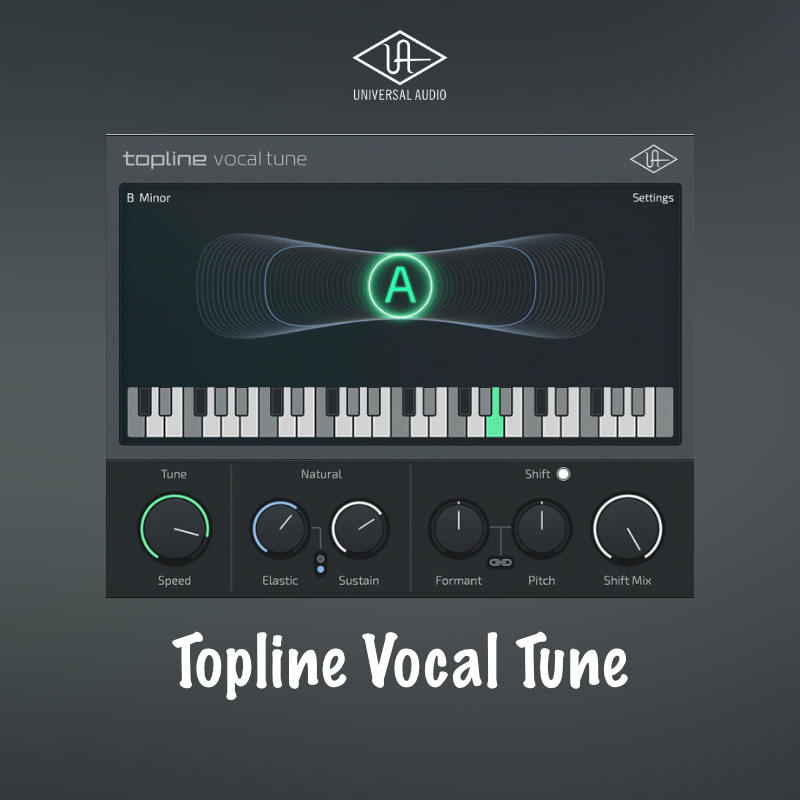
$99.
Runs natively and on compatible Apollo DSP, which is the real reason to choose it: near-zero-latency monitoring through the interface rather than the host. Key Finder, custom scale definition, formant and pitch shift, MIDI repitching, and Elastic, Expressive and Sustain controls aimed at keeping slides and vibrato intact rather than flattening them.
Where it stops: a focused tuner, not a vocal effects rack, at roughly three times the price of NEOTUNE Pro.
3. bx_crispytuner – automatic and graphical together
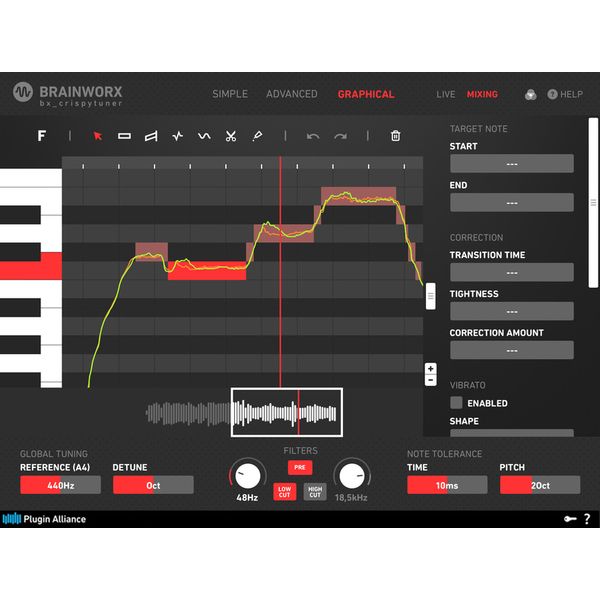
$100 list, $19.99 sale observed.
Simple, Advanced and Graphical modes with the bx_crispyscale key detector included. Live mode is described as zero latency, and graphical mode lets you draw changes after the take. On sale that is a lot of capability.
Where it stops: the interface is heavier than a live rig wants, and there is nothing after the tuning.
4. Auburn Sounds Graillon 3 – free and genuinely usable
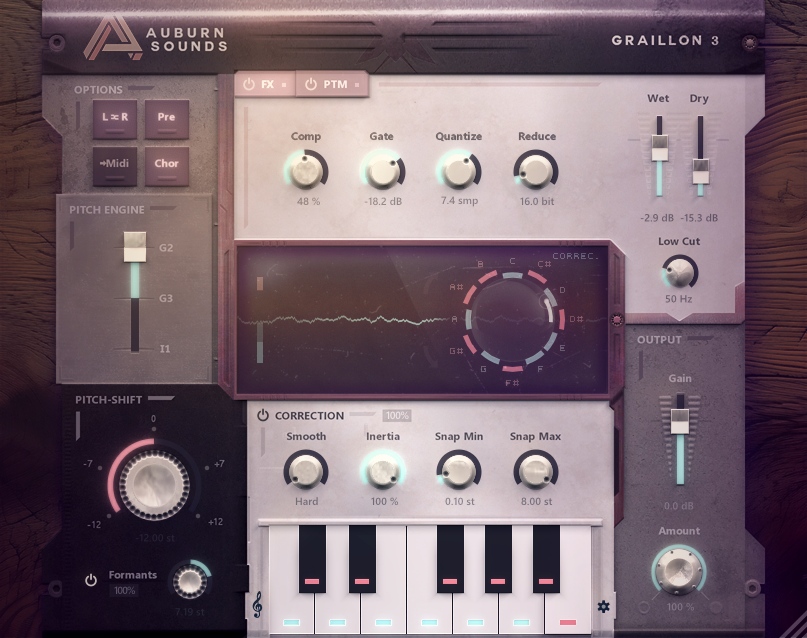
Free, $29 for the full edition.
Real correction at no cost with a character of its own. The full edition adds microtuning. Low CPU and few controls, which on stage is a virtue rather than a limitation.
Where it stops: basic scale handling, no clean-up stage, nothing after the correction, and latency that is fine rather than class-leading.
5. Your DAW’s stock tuner – already paid for
More people own a real-time tuner than realise. FL Studio Producer Edition and above ships Pitcher, Cubase ships Pitch Correct, Logic Pro has a real-time Pitch Correction plugin, and Reaper ships ReaTune with a real-time mode. All do key, scale and retune speed.
Where they stop: basic scale libraries, no clean-up, nothing after the correction. Open yours before spending anything.
Latency: what actually matters
Three separate delays get conflated.
Plugin latency is what the tuner introduces. Fixed, and your DAW reports it.
Buffer latency is your interface setting, and it is almost always the larger number. A 512-sample buffer at 44.1 kHz is about 11.6 ms each way before any plugin is involved.
Round-trip latency is what the singer actually experiences, and it is the number to measure. Your interface software usually reports it.
If monitoring feels bad, drop to a 128 or 256 sample buffer while tracking and put only the tuner on the channel. Almost every “this plugin has too much latency” complaint is solved at the buffer, not the plugin.
Live rig notes
- Run a standalone app if the host is one more thing to go wrong.
- Narrow the detection range to the singer’s register, which makes the tracker far harder to confuse with monitor bleed.
- Use the low cut aggressively. Stage rumble is the single biggest cause of a tuner chattering live. 100 Hz or higher on most voices.
- Decide your failure mode in advance. If the plugin drops out, does the dry vocal still reach the PA?
- Check the licence works offline.
Frequently asked questions
Is there a free alternative to Waves Tune Real-Time? Graillon 3 and your DAW’s stock tuner both do real-time correction at no cost. Neither matches it for live monitoring, but both are usable at mixdown.
Is NEOTUNE Pro cheaper than Waves Tune Real-Time? Yes, $29.99 against $29.99 at the time of checking. Price is the smaller difference though. One is a focused tuner, the other adds clean-up, harmony, formants, talkbox, FX and MIDI in the same window.
Does Waves Tune Real-Time do harmony? No, it is pitch correction only. Waves sells Waves Harmony separately for that.
What retune speed should I use live? Around 10 to 20 ms. Fast enough to hold a singer, slow enough that the stepping is not audible through a PA. See retune speed explained.
Why does my live vocal warble through the tuner? Stage noise reaching the pitch tracker. Roll off the low end hard, narrow the detection range, and check for monitor bleed into the vocal mic.
Can I use a pitch corrector on guitar or synth? On monophonic sources usually yes. On polyphonic material no, because detection needs one note at a time. That is also why you tune each vocal layer separately rather than a stacked bounce.
Does NEOTUNE Pro replace Waves Tune Real-Time exactly? Not exactly. It corrects in real time and adds everything that normally follows the tuner, but Waves is more narrowly optimised for the lowest monitoring latency.
NEOTUNE Pro: real-time correction with harmony, talkbox and vibrato built in, 37 scales, and a standalone app for playing live without a DAW. $29.99. See the plugin.
Related: 7 best Auto-Tune alternatives and the best autotune plugins of 2026.
The post Waves Tune Real-Time Alternatives: 5 Options Compared (2026) appeared first on Producer Sources.