Quick answer: Pick a dark minor key, play a sparse plucked line (leave space), slide
into notes for emotion, then drench it in reverb and a touch of delay so it floats behind the
808. Use a playable guitar VST for custom lines, or flip a loop if you don’t play.Part of our complete guide to instrument plugins.
Guitar-led trap and drill lives on the melody — those dark, wet, plucked lines that carry the
whole beat. Learning how to make trap guitar melodies is less about shredding and more about
note choice, space and processing. Here’s the process, step by step. (For the tools, see our
best VST plugins for trap guitars.)
Step 1 — Start in a dark minor key
Trap guitar leans emotional and menacing, so a minor key does most of the work. Try A minor,
E minor, F minor or C# minor. Stay in the natural minor (or harmonic minor for a Spanish
flavour) and your notes will sound right by default.
Step 2 — Get your guitar sound
You have two routes:
- A playable guitar VST — best when you want to write your own lines and control every note.
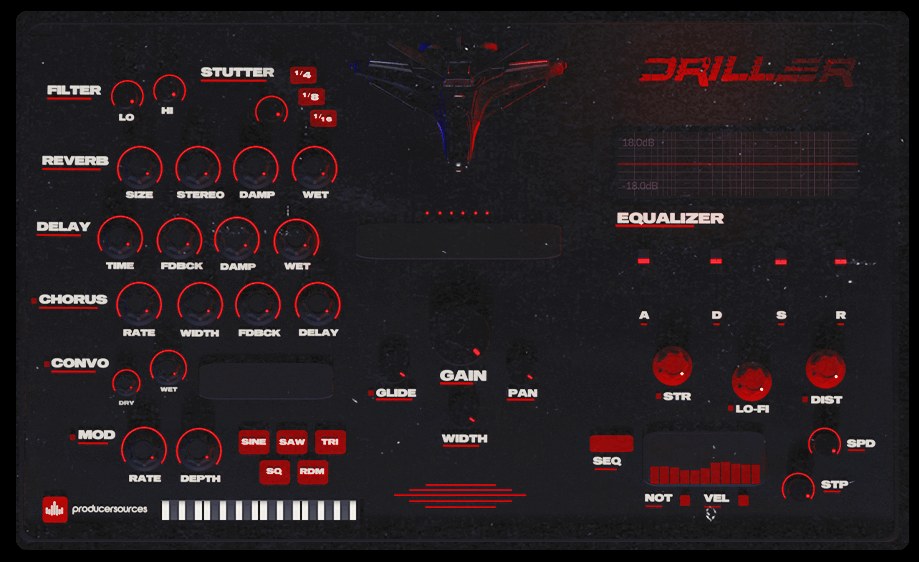
DRILLER includes
newly designed guitars alongside 800+ other sounds, so you can play the melody and build the
rest of the beat in one plugin. - Guitar loops / sample packs — best for instant, professionally played phrases to flip if
you don’t play guitar.
Hear DRILLER’s guitars in action:
Check out DRILLER here →
Step 3 — Play sparse, leave space
The biggest mistake is playing too much. Trap guitar melodies are sparse — a short motif
with gaps that the 808 and hats fill. Play a 2–4 note phrase, let it breathe, and repeat it with
small variations. Space is what makes it hit.
Step 4 — Use slides and bends for emotion
Slide into notes and add small bends — that wet, vocal-like expression is the signature of a
great trap guitar line. If your plugin supports legato or pitch glides, lean on them.
Step 5 — Process it: reverb, delay, lo-fi
This is where a dry line becomes a hook:
- Reverb to float it behind the beat (a plate or hall works well).
- A touch of tempo-synced delay for depth without mud.
- Lo-fi / vinyl texture for grit and character.
- EQ out the low-mids so it sits above the 808.
Step 6 — Layer and pan for the hook
For the chorus, double the line (or layer an octave) and pan the two takes for width. A single
mono guitar in the verse, widening into the hook, gives your beat an arc.
FAQ
What key are trap guitar melodies in?
Usually a dark minor key — A, E, F or C# minor are common. Harmonic minor adds a Spanish edge.
Do I need to play guitar to make trap guitar melodies?
No. A playable guitar VST lets you program lines with a MIDI keyboard, and guitar loop packs give
you played phrases to flip.
How do I make my guitar melody sound like real trap?
Play sparse lines in a minor key, slide into notes, and process with reverb, a little delay and a
lo-fi texture so it sits wet and emotional under your 808s.
The post How to Make Trap Guitar Melodies (Step-by-Step) appeared first on Producer Sources.