New IMS Business Report highlights rising revenues, expanding audiences and continued genre resilience in 2025.
The global electronic music industry generated $15.1 billion in 2025, according to the latest IMS Electronic Music Business Report, reflecting a 7% year-on-year increase and a slight acceleration compared to 2024. The report, produced by MIDiA Research and presented at IMS Ibiza, outlines sustained growth across multiple revenue streams alongside continued global audience expansion.
Now in its twelfth edition and authored by MIDiA’s Mark Mulligan, the report presents a detailed overview of the sector’s commercial performance and cultural reach. The findings suggest that electronic music remains one of the most globally consistent genres, maintaining relevance across diverse markets while adapting to shifts in technology and consumption.
Diversified Revenue Streams
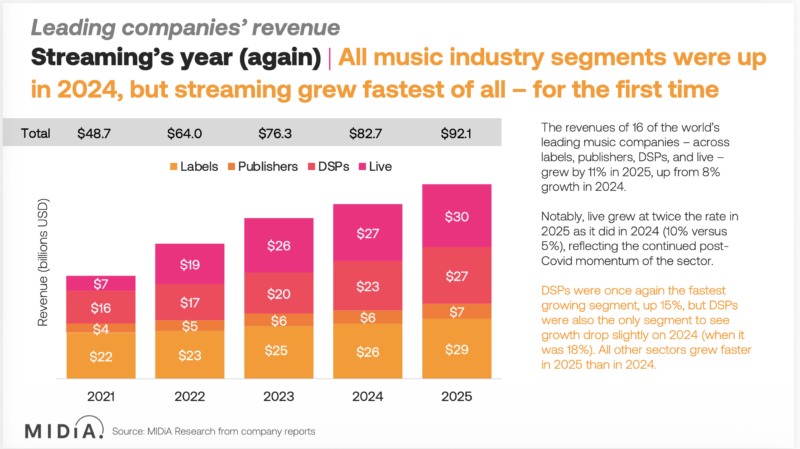
Growth in 2025 was supported by gains across publishing, digital streaming platforms (DSPs), and merchandise, indicating a broader shift away from reliance on a single revenue source. Recorded music revenues rose by 9%, while publishing increased by 11%, reflecting wider trends across the global music business.
Subscriber numbers also continued to climb, reaching 919 million worldwide. Much of this growth is being driven by markets in the Global South, where streaming adoption is reshaping the geographic balance of the industry. The report highlights how electronic music has benefited from this expansion, maintaining a strong presence across international audiences.
In parallel, investment activity remained notable. Electronic artists accounted for 18% of catalogue acquisition deals in 2025, signalling continued interest from investors in newer catalogues with long-term streaming potential and engagement among younger listeners.
Audience Growth And Platform Influence
Electronic music’s global fanbase expanded significantly during the year, with an additional 600 million followers across platforms including Spotify, YouTube, TikTok, Instagram and Facebook. While this represents a slower rate of growth compared to previous peaks, it aligns with trends seen in other major genres.
On TikTok the #ElectronicMusic hashtag racking up 3 million creations in 2025 – up 50% year-on-year and 106% since 2022. Niche subgenres are growing especially fast: #SpeedGarage was up 147%, #Garage up 75%, and #Techno up 66%. In the UK, house, rave, techno, and electronic music all sit within the top ten music hashtags on the platform.
On SoundCloud, electronic music accounts for one in three of all uploads, up from one in four in 2020, and is the top genre in the UK and second in the US. DJ set uploads grew 39% year-on-year in 2025. The platform’s scenes rankings – essentially a map of the global underground – tell a more textured story than genre charts alone. Vinahouse, hard/industrial techno, and minimal/tech house are the top global electronic scenes, while Indonesian breakbeat, South Korean EDM, and Colombian guaracha are among the fastest growing. The overall direction of travel is harder and faster. The percentage of hardstyle, hardcore, and hardtekk tracks topping 180 BPM has increased every year for the past three years, and schranz – saw uploads jump 83% in 2025.
The report suggests this is not coincidental. Music tends to get harder and faster when the wider world feels turbulent, and 2025 provided no shortage of turbulence.
Germany And The Global South Drive Streaming
Germany retained its position as the largest market for electronic music listeners, with audience growth of 11% across key territories. The genre now ranks among the top three in most major markets, reinforcing its cross-cultural appeal.
On Spotify, Germany boasts 604 million monthly listeners – more than seven times the country’s actual population, a reflection of how the cumulative metric works but also a sign of the country’s unrivalled dominance in the space. The US, Australia, UK, and Netherlands round out the top five, and Australia and the Netherlands join Germany as markets where electronic music listeners exceed five times the national population.
Globally, electronic music ranks first or second on Spotify in ten of its thirteen top markets, ahead of hip hop, Latin, and rock. The sole exception is Mexico, where Latin music dominates. The report also cautions against reading too much into Latin music’s apparently huge global numbers – ten of its thirteen top markets are Spanish-speaking, making it more of a regional phenomenon than a truly global one.
Fans Are Unusually Devoted
Electronic music’s fanbase isn’t just large – it’s deeply engaged. According to MiDiA’s consumer research, electronic music fans listen to an average of 10.4 hours of music per week and spend $24 a month on live music and $17 on recorded music. They over-index heavily on scene participation, with 74% saying it’s important to connect in real life, compared to 64% of the general population. Dance fans, in particular, place greater emphasis on shared activities, like-minded communities, and a sense of belonging than almost any other musical tribe.
Genre Trends & Live Sector Resilience
At a genre level, tech house remained the best-selling category on Beatport, continuing a multi-year trend. Meanwhile, Afro house has emerged as a fast-growing segment, particularly on production platforms such as Splice, reflecting increasing interest in newer, developing genres and production sounds.
The live sector also remains buoyant. Ibiza continues to serve as a key benchmark, with club ticketing revenues reaching €160 million in 2025. This increase occurred despite fewer events, indicating a gradual shift towards higher-value experiences and concentrated demand.
AI – The Conversation That’s Here To Stay
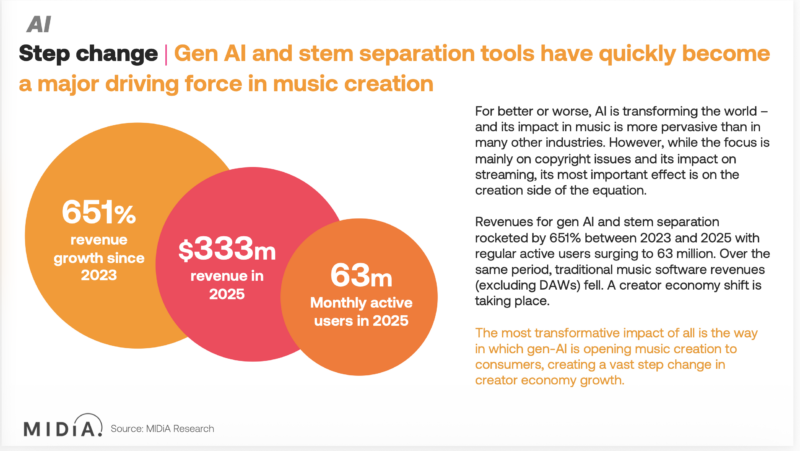
The report also identifies rapid growth in the use of generative AI and stem separation tools within music production. Revenues from these technologies increased by 651% between 2023 and 2025, reaching $333 million, while monthly active users rose to 63 million. This expansion reflects a shift in how music is created, with a growing number of producers and non-professional users adopting AI-assisted workflows.
Alongside this growth, revenues from more traditional music software categories, excluding DAWs, declined over the same period. The data points to a broader transition within the creator economy, where accessible, AI-driven tools are lowering barriers to entry and expanding participation in music production.
Outlook For 2026
The IMS report’s conclusion is quietly optimistic but pointed: in an era of AI-generated content and algorithmic homogenisation, electronic music’s scenes culture its emphasis on real-life connection, shared experience, and underground innovation – gives the genre a resilience that revenue figures alone can’t fully capture. The dancefloor, the report suggests, has never mattered more.
Download the full IMS Business Report here (for free).
International Music Summit (IMS) is an annual conference focused on the business, culture and technology of electronic music, held in Ibiza. It brings together industry professionals, artists and companies to discuss trends, data and developments shaping the global electronic music. Find out more here.
[social-links heading=”Follow Attack Magazine” facebook=”https://www.facebook.com/attackmag” twitter=”https://twitter.com/attackmag1″ instagram=”https://www.instagram.com/attackmag/” youtube=”https://www.youtube.com/user/attackmag” soundcloud=”https://soundcloud.com/attackmag” tiktok=”https://www.tiktok.com/@attackmagazine”]
[product-collection]