Arturia’s Pre SUB was designed for 808s and Reeses, making it now easier than ever to dial in massive bass. It’s surprisingly affordable too.
The specification of plugins continues. For some reason now, we’re all really busy and don’t have the time to design our synth patches. (Yes, the reason is late-stage capitalism, but anyway.) We all love our Divas and Massives and Pigments, but increasingly we’re turning to speciality instruments that do one type of sound really well.
The latest soft synth to come along that does bass really well is Pure SUB from Arturia, a laser-focused plugin with just one thing on its mind: face-melting bass of the 808 and Reese variety. Think jungle, UK garage or any of your many 140 genres. Love the low end? Then you’re very much going to want to read on.
Bass For Your Face: Sound Generation
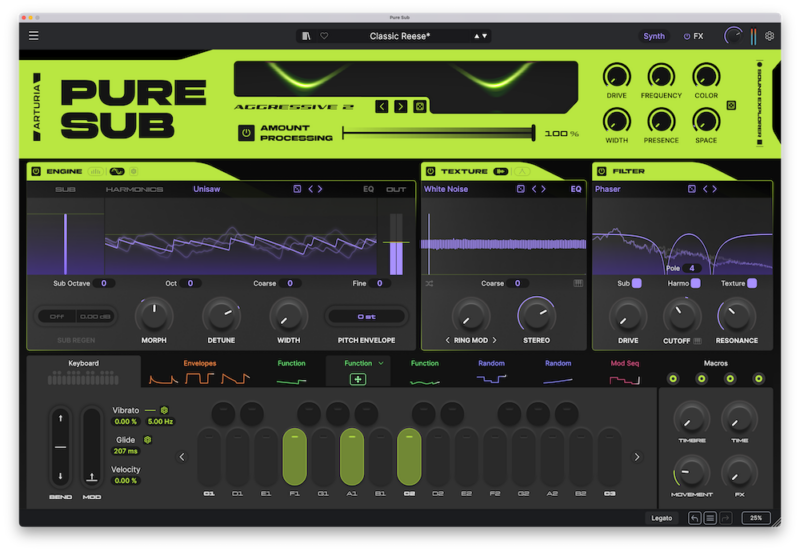
Pure SUB may be confined to a single type of sound, that being sub-heavy bass, but that doesn’t mean it isn’t a complex instrument. It’s incredibly flexible, with a lot of different ways to generate, modulate and process sound.
Starting at the sound generation stage, the monophonic Pure SUB gives you just a single oscillator to work with. However, it breaks this into three sections with separate processing at each stage for maximum sound design potential.
Every bass begins with a fundamental, and that’s handled here by a clean sine wave in the Sub chamber. You can control the amount of volume of the sub (as you can with the Harmonics and Texture sections as well). You can set the octave of the sub (0 to -2) as well as select how to route the sub through the rest of the synth, either processed along with the Harmonics and Texture or sent to the master at certain points of the signal chain, such as after the filter or effects. It’s a little thing but incredibly helpful and saves you having to generate a separate sine sub track in your DAW.
Next comes the Harmonics, with two separate sound engines for generating mid-bass content, Pressure and Reese. Pressure is an additive engine for 808s and other solid basses. This is more complex than it first appears, with an editor screen for crafting complex harmonic layouts. There are actually three additive states to morph between, with starting preset waves and a drawing mode for customization. Reese, on the other hand, is of the wavetable variety, with a large selection of tables to choose from, all with an aggressive edge. You can also import your own. Standard across both of these are controls for Morph, Detune and Width, with a basic EQ on hand for tone shaping.
Lastly, Texture is the noise module. If you’ve been paying attention lately, you’ll know that clean subs are for suckers, with bass design favoring scratchy and nasty top ends. Pure SUB gives you a selection of noise samples (plus an option to import personal favorites) plus a VA noise generator. Use the additional controls to rough up the noise even more.
Lastly, there’s a single filter but it’s packed with filter models pulled from Arturia’s own Pigments. Some of the more recent ones from Pigments 7 like Rage really come into their own here. Usefully, the filter lets you turn each of the three sound generator stages on and off to keep them clean or not. Very helpful.
Move Something: Modulation
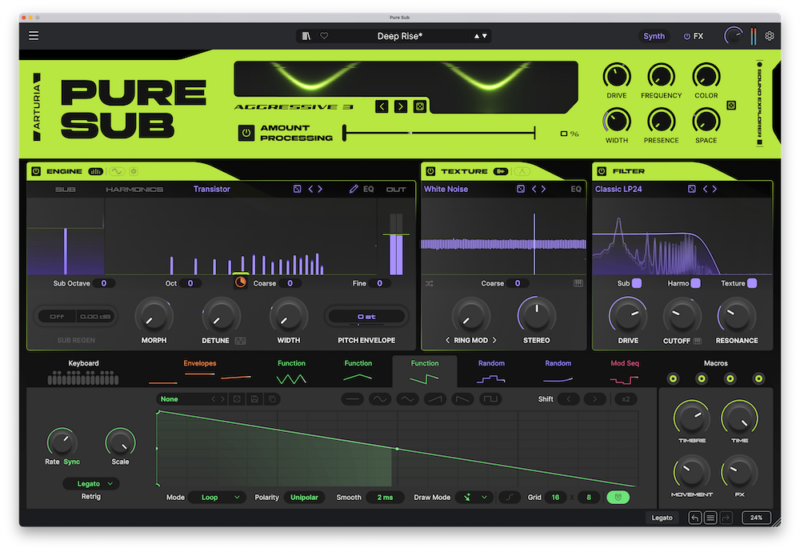
Speaking of Pigments, if you’ve worked with Arturia’s flagship synth at all, you’ll feel instantly at home with the modulation section in Pure SUB. It’s got the same style of drag-and-drop assigning, with animated graphics that display speed and shape of sources. If you haven’t used Pigments before, you’ll wonder how you ever managed to program anything in an instrument that didn’t have this genius modulation system.
Being all about that bass, Pure SUB has the pitch envelope placed first on the Envelope page, with a dedicated amount control in the Engine section. This lets you whip up 808s quickly. Of course, you also get an amp envelope and additional mod envelope for the filter or whatever else you want. Function generators, random generators as well as voice and step modulators round out the source types.
There are also four assignable macros, useful for quick adjustments to multiple parameters simultaneously.
Dial In The Filth: Effects Processing
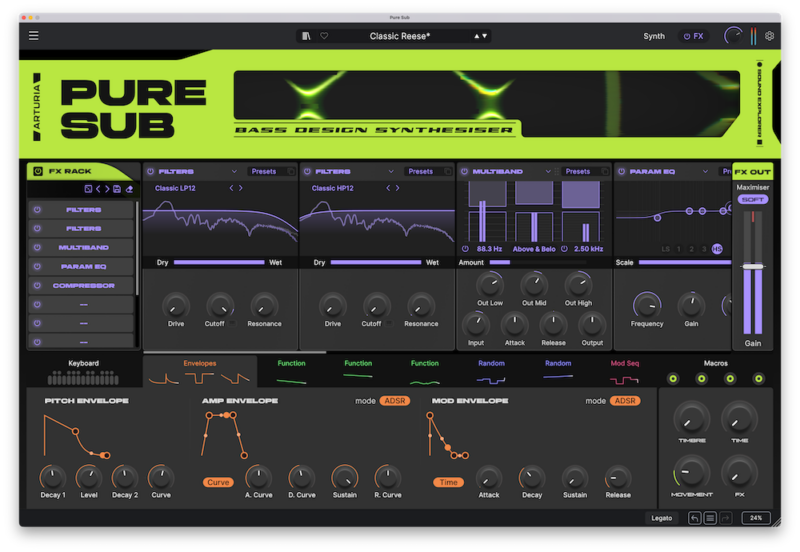
You might not expect Pure SUB to have as extensive an effects section as it does, but the synth really is full to bursting with ways to process your sound. There are actually two sections, the Sub Processor and the general FX page.
The Sub Processor is at the top of the screen and married to the main page. Here you get Drive, Frequency, Color, Width, Presence and Space knobs, with an Amount Processing slider for balancing wet and dry. This sounds great when modulated by a function generator.
Click the FX button at the top and you’re brought to a new page, with an effects rack on the left and slots for individual units on the right. There are 17 different types to choose from, each with its own set of presets. (This is true of pretty much any section in the instrument, actually.) Use the rack to swap effects around and change the order. You’ll recognize a lot of these from other Arturia products.
It’s too bad that the Sub Processor disappears on the FX page, leaving a blank space in its wake. The two sections work hand in hand, and dialing in effects would be easier if they could both be visible at the same time.
Making an 808
Now that we know how it all hangs together, let’s look at making a sound. First, let’s try an 808.
We load up a default patch. It’s already set to the Pressure additive engine, so we choose an 808 preset from the dropdown menu. 808 6 has a nice balance of sub and upper harmonics. We increase the amount being sent to the pitch envelope to 24 st and adjust the pitch envelope itself until we have a shape that is both kicky and subby.
Here’s what that sounds like:
Next, we dial in white noise and assign the filter cutoff to a function generator so it opens as the 808 booms. We then set the filter type to Rage Distortion, up the amount of Rage to 25% and dial in Drive on the filter circuit as well. Lastly, we play with the Sub Processor, increase the amount of processing to around 60% and add a multiband compressor on the FX page set to OPP (Arturia’s version of OTT) to really exaggerate all of the nastiness.
So nasty:
Making a Reese
Let’s try a Reese this time. We return to default, choose Broken Reese 1 wavetable from the Advanced Reese folder in the Reese engine, and turn up Morph, Detune and Width, all to about 2 o’clock. We switch off Texture.
Start of the Reese:
Next, we choose the Phaser filter model and assign the cutoff to a function generator set to bipolar, with a slower rate than the default. Lastly, we choose the Aggressive 1 preset in the Sub Processor and adjust to taste, then add a compressor, distortion, flanger, a notch filter free running, an additional filter to tame the highs and a reverb to finish off the effects chain. Finally, we set the sub so it arrives clean at the master out, extend the MIDI notes and engage glide.
Finished Reese:
And, for a final example, here’s a dubstep track we put together using three instances of Pure SUB plus two loops from Splice and an arpeggiator preset in Ableton Live.
Pure SUB in context:
The Final Word
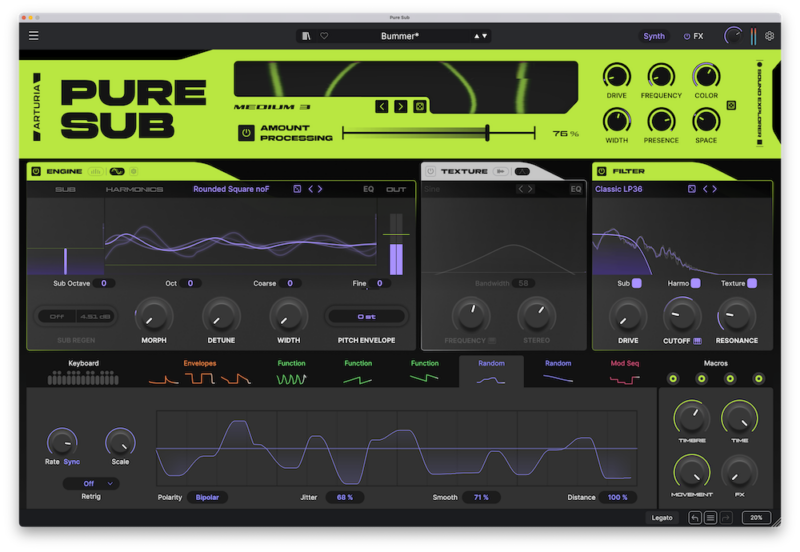
Clearly, how much you’ll get out of Pure SUB will depend on how in love you are with 808s and Reeses. If that’s you, you’ll discover plenty to keep you busy. If it’s not, you may find Pure SUB to be something of a one-trick pony. This is where Rumble from UVI, another bass synth, has the edge, as it can handle more than just booms and tears. At a wallet-troubling regular price of $199, though, it’s also significantly more expensive than Pure SUB’s regular price of €79. It’s actually even cheaper now at €49.
Pure SUB is gangbusters at what it does. We could argue that it could do more (Moog-style basses wouldn’t go amiss) but at this price, you really can’t complain, can you? It sounds superb, it’s super fun to use, and with all of the effects on board you can get a wide variety of sounds out of it. You may never go back to Phase Plant again.
[rating buy=”Arturia Pure SUB” price=”€79 (€49 intro sale)” link=”https://www.arturia.com/products/software-instruments/pure-sub/overview?utm_source=Press&utm_medium=attackmag&utm_campaign=R_attackmag_Article__Rumble_Prospects_06_26″ value=”5″ versatility=”4″ sound=”5″ ease_of_use=”4.5″ overall=”4.5″ text=”If you’re all about that bass you need Pure SUB in your life.”]
[social-links heading=”Follow Attack Magazine” facebook=”https://www.facebook.com/attackmag” twitter=”https://twitter.com/attackmag1″ instagram=”https://www.instagram.com/attackmag/” youtube=”https://www.youtube.com/user/attackmag” soundcloud=”https://soundcloud.com/attackmag” tiktok=”https://www.tiktok.com/@attackmagazine”]
[product-collection]