Quick answer: Use algorithmic reverb for most lead vocals — it’s flexible and easy
to shape. Use convolution when you want a specific, believable real room, usually on
background or cinematic vocals. Better still, use a plugin that gives you both.Part of our complete vocal reverb guide.
If you’ve compared reverb plugins you’ve hit the two big families: convolution vs
algorithmic reverb. They create space in fundamentally different ways, and knowing which is
which lets you reach for the right sound on a vocal instantly. This is part of our
complete vocal reverb guide.
How algorithmic reverb works
Algorithmic reverb generates space mathematically — networks of delays and filters model how
sound bounces around a room. Because nothing is baked in, you can freely shape decay, size,
tone and modulation. That flexibility is why algorithmic reverb is the default for lead
vocals: you can dial the exact space the song needs, from a tight room to an endless hall, and
tweak it as the mix evolves.
Strengths: flexible, tweakable, great modulation, CPU-friendly, endlessly musical.
Watch-outs: at extreme settings it can sound slightly synthetic if you’re chasing realism.
How convolution reverb works
Convolution reverb uses an impulse response — a recording of how a real space (a
cathedral, a studio chamber, a plate) responds to sound. The plugin “stamps” that real space
onto your vocal, so it sounds genuinely like the voice was recorded there. The trade-off is
flexibility: you’re working with a captured space, so it’s harder to bend far from the
original.
Strengths: authentic, realistic spaces; unbeatable for a specific real room.
Watch-outs: less tweakable; heavier on CPU; big libraries to manage.
Which should you use on vocals?
- Lead vocals (pop, rap, R&B): algorithmic — you want control and easy shaping.
- Background vocals / ad-libs: either; convolution can add a believable room glue.
- Cinematic / atmospheric vocals: convolution for a real, immersive space.
- When you’re unsure: start algorithmic; it’s the more forgiving default.
You don’t have to choose: get both
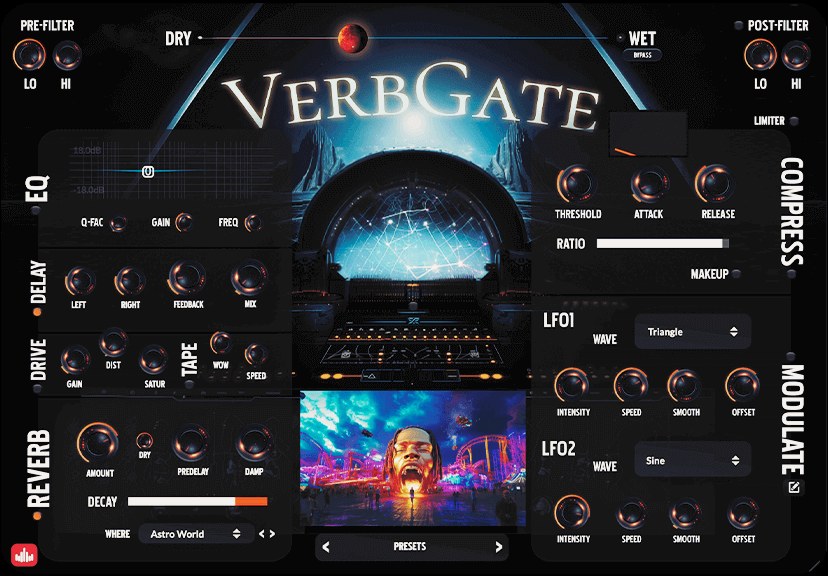
The best modern move is to have both engines on hand. VerbGate
combines algorithmic and convolution reverb in one plugin, with a library of over 100
spaces and a built-in gate — so you can grab algorithmic flexibility or real-room convolution
character, and keep either one controlled behind the lead. It’s the simplest way to stop
worrying about which type you own and just pick the right space for the song.
For a full ranked comparison of vocal reverbs, see our
best reverb plugins for vocals.
FAQ
Is convolution or algorithmic reverb better for vocals?
Algorithmic for most lead vocals because it’s flexible and easy to shape. Convolution shines
when you want a specific, believable real room, usually on background or cinematic vocals.
Does convolution reverb use more CPU?
Generally yes — convolution is more processor-heavy than algorithmic reverb, though modern
plugins and machines handle it comfortably.
Can one plugin do both?
Yes. VerbGate combines algorithmic and convolution reverb with a gate, so you get both types
and keep the tail controlled behind the vocal.
The post Convolution vs Algorithmic Reverb for Vocals: Which to Use appeared first on Producer Sources.